Key Points for Installation and Usage
1.Before installing, check if the products are damaged during transportation. Check the technical specifications(working pressure, working
temperature, working voltage, etc).
2.Complete cleaning of pipeline is required, in order to remove dust,particles,oil, etc(complete blow via air-blow gun, or empty the front-end
piplines completely)
3.Particles in the medium will speed-up the wearing of valve seat and amature, causing leakage or even completely disabling the product.
Filter should be installed at the inlet of the valve.40μm air filter element or filter nets of 80-100μm is recommended. And filter element/filter
net should be cleaned/replaced regularly.
4.The debris of piple thread and sealing tape shall not get inside the valve when mounting the valve fittings to the pipe. When using sealing tape,
do not apply the tape onto the first 1.5-2 thread pitchs.
5.The coil shall be mounted vertically and upward. The inlet and outlet of the valve should be horizontal(for the inlet/outlet,a tilt angle up to 45
degree is acceptable if mounting space is limited. However, the coil should never be pointed downward). Also, make sure the direction of pipe
connection matches the marks on the valve(examples of signs/marks: In/out, or 1/2, In/1(inlet) or other marks like directional arrow(→)
6.No external force is allowed on the coil.When the coil is screwed into the pipe, clamp the wrench on the mounting position on the pipe only.
7.Grounding of the pipline is not allowed. Oitherwise, this will cause electrochemical corrosion of the system.
8.Please install overflow valve in pipeline, in order to prevent the accumulation of fluid in the pipe.
9.Do not cover the coil with any thermal insulation material. This will cause the coil overheat and damage the coil.
10. Though the coil is calibrated as 100% ED, continuous switch-on over a long period of time can result in overheating, which will accelerate
aging of the insulation, decrease performance of the solenoid valve, and reduce coil life and cause more energy consumption from overheating.
Therefore, if needs to switch on continuously for a long time, it shall consider to use normal open solenoid valve or use energy-saving low-power
consumption coil, to extend coil life and save energy.
11.Do not mount the valve in the places that have strong vibration. If this cannot be avoided,please set the arm of force to minimal to avoid
resonance.
12.The diameter of the cable should be larger than 5mm2 . No additional force should be applied to the cable.
13.No Electro-self-sustained oscillation is allowed in the electrical circuit for the valve.
14.The solenoid valve coil can not be connected to wrong voltage (such as DC24V coil connected to AC220V voltage), the coil shall be assembled
with valve body before switch on, otherwise it will burn the coil. And the voltage applied shall be within the specified voltage range, so as to avoid
valve malfunction.
15.The fluctuation of the voltage should be within -10%~+10% of the standard voltage. When DC responsiveness is very important,the
fluctuation of the voltage should be within -5%~+5% of the standard voltage. The voltage should be lowered to the voltage of the cable connecting
to the coil.
16.The disconnecting voltage for AC type solenoid valve should be lower than 20% of the standard voltage. For DC type, the disconnecting
voltage should be lower than 2% of the DC valve.
17.If the valve needs to be storaged for prelonged peroid after using water-type fluid, the water and moisture should be completely removed,to
prevent the generation of stain and the corrosion of the rubber parts.
18.The required period for valve-state changing is influenced by the type and characteristics of the fluid. When using pure water as standard,
please change the state of the valve(from open to close, and vice-versa) at least once every 10 days. If the peroid is longer than 10 days,
detecting system should be installed. The valves should be inspected every half a year at the minimal, in order to keep the valve in optimal
working condition.
19.Tips against harmful condensation and freezing:Condensation and freezing of water should be prevented when the valve is used under low
temperateure. A high dew-point temperature, the low temperature of the environment and large flow passing through the valve may lead to
freezing. Air dryer and thermal insulation of the valve body should be used as prevention method. However, the coil should not be exposed to
heater, or covered by thermal insulation material.
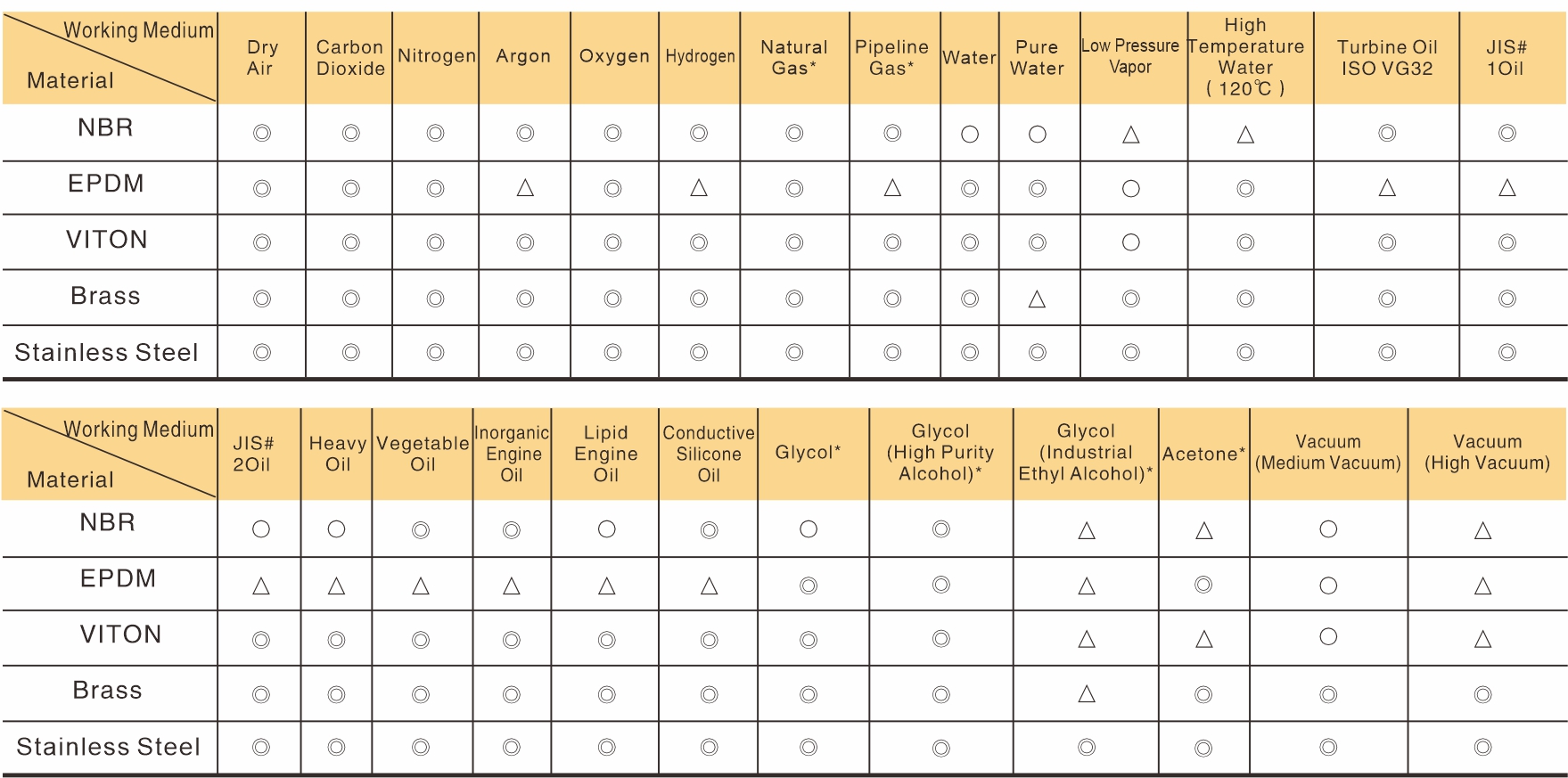
20.Please ensure the compatibility of the fluid and valve materal when choosing the valve type. As a general reference, the maximum viscosity
of the fluid should be no higher than 50cst.
21.The leakage of valve's inlet and outlet should be strictly prohibited when the valve is used for combustable oil and gas. Also, Explosion-proof
coil should be chosen.
22.When the pipeline does not accept oil, please choose oil-prohibitive types of valve and parts.
23.Before maintainence of the solenoide valve, Electricity should be cut off, upstream fluid should be shut down, the pressure inside the pipeline
must be removed.
24.The surface temperature is high for coil surface(especially true when the valve is used for high temperature fluid), therefore, there's a risk of
injury due to burn when personall directly contacts the valve and coil.
25.For pilot type 2/2 solenoid valves,the moment of start-up of fluid supplying source(pumps, compressors, etc) will introduce a a sudden
increase of pressure, this may cause the valve to open momentarily, even when the valve is closed. This may cause the leakage of the fluid,
please be cautious.
26.The thread size of the fluid inlet should not be smaller than the orifice of the valve body. Otherwise, when the valve is opened, the difference
between in/out air pressure may be lower than the minimal difference of acting pressure. This may cause the vibration of diaphragm for pilot type
solenoid valves.
27. When the pilot valve is closed, the pressure is above the minimum operating pressure difference, but due to bending or throttling of the supply
piping (like pump, compressor, etc.), please note that the differential pressure may be lower than the minimum operation differential pressure
when the valve is opened, which leads the valve can not be fully opened or the diaphragm vibrates abnormally.
28.Please refer to low power solenoid valve instructions when using low power solenoid valves.