Precautions for Product Operation
I. Before Installation: Preparation and Inspection (The First Step in Leak Prevention)
1. Model and Specification Matching
- The thread specifications of the connectors (PT/NPT/G), the outer diameter of the air hoses (φ4/6/8/10/12mm), and the working pressure/temperature must be completely consistent with those of the system and the air hoses.
- Mixing connectors from different brands or series is prohibited, as there are differences in the sizes of internal locking claws and sealing grooves.
2. Component Integrity Inspection
- Connector Body: It should be free of cracks, deformations, missing teeth, and damaged locking claws.
- Sealing Ring (O - ring): There should be no signs of aging, cracking, breakage, or lack of rubber.
- Air Hose: It should have no scratches, bulges, discoloration, or flattening; only new and intact air hoses should be used.
3. Strict Pretreatment of Air Hoses (Crucial)
- Cutting: Use a special pipe cutter to cut the hose vertically. The cut must be flat without any bevels.
- Deburring: Remove both internal and external burrs completely. Rough or sharp edges are strictly prohibited as they can scratch the sealing ring.
- Cleaning: Blow out dust, oil stains, and debris from both the inside and outside of the air hose.
4. System Safety
- Before installation or disassembly: Close the air source → Completely release the residual pressure in the pipeline → Confirm that the pressure is 0.
II. During Installation: Correct Connection (The Core of Leak Prevention)
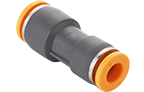
1. Quick - Connect Fittings (Push - in Type)
- Vertical Insertion: Insert the air hose straight and align it with the center of the fitting without any tilt or twist.
- Insert to the Bottom: Push it firmly to the bottom until a “click” sound is heard (indicating that the locking claw is in place).
- Pull - Out Test: After insertion, gently pull the air hose to confirm that it cannot be pulled out.
- Threaded End (External Thread)
- Teflon Tape Wrapping: Wrap the teflon tape clockwise for 2 - 3 turns (starting from 2 - 3 teeth at the end of the thread), without blocking the inner hole.
- Tightening Torque: Follow the torque specified in the specification table (e.g., for G1/8 ≈ 7 - 9N·m). Over - tightening is prohibited as it may crack the body or damage the seal.
2. Threaded/Compression Fittings
- Compression Sleeve: Pre - tighten it evenly and then turn it 1 - 1.25 turns (so that the compression sleeve cuts into the pipe wall).
- Metal Pipe: Deburr and chamfer the pipe end.
III. During Use: Operation and Environment (Extending Service Life)
1. No Load - Bearing
- The fittings should not bear tensile, torsional, or bending forces.
- The air hose should have a natural routing with some slack. The bending radius should be ≥ 5 times the outer diameter of the air hose.
- In vibrating or moving applications, use fixed brackets or corrugated pipes for protection.
2. Pressure and Temperature
- Use within the rated pressure and temperature range (e.g., - 20℃~60℃, 0 - 1.0MPa).
- Over - pressure or over - temperature conditions can cause the sealing ring to age rapidly and the fitting to deform.
3. Environmental Protection
- Dust/Chips: Use dust caps or protective covers.
- Oil Stains/Chemicals: Select oil - resistant or corrosion - resistant materials (NBR/FKM).
- Outdoor/Wet Conditions: Apply waterproof and rust - proof treatments.
4. No Mixing of Media
- Only use dry and clean compressed air. Special media (such as vacuum/inert gas) require dedicated fittings.
IV. Disassembly: Standard Operation (Preventing Damage)
- Quick - Connect Fittings:
1. First, relieve the pressure → Press the release sleeve (press it completely).
2. At the same time, gently push the air hose and then pull it out smoothly.
3. Forcibly pulling or twisting is prohibited as it may damage the locking claws or the sealing ring.
- Threaded Fittings:
- Loosen the fittings symmetrically and gradually; do not wrench one - sidedly and forcefully.
V. Maintenance and Leak Detection: Fault Prevention
1. Regular Leak Detection (Necessary)
- Method: Apply soapy water or leak - detection liquid to the fittings. No bubbles indicate a passing test.
- Frequency: Check every 200 hours or once a week.
2. Replacement of Worn - out Parts
- Sealing Ring: Replace NBR seals every 2 years and FKM seals every 3 years. Replace immediately if there is hardening, cracking, or deformation.
- Locking Claw/Body: Replace the entire unit when there is wear, deformation, or irreparable leakage.
3. Cleaning and Lubrication
- Regularly blow out internal impurities.
- For moving parts (such as the locking sleeve/steel balls): Apply a small amount of silicone - based or lithium - based grease every 500 hours.
- For threads: Apply an anti - seize compound before disassembly and assembly to prevent seizure.
VI. Common Mistakes and Consequences
❌ Oblique cut or burrs on the air hose → Scratch the sealing ring, resulting in permanent air leakage.
❌ Incomplete insertion → The fitting may fall off under pressure, causing serious leakage.
❌ Over - tightening of the thread → The fitting may crack and the thread may strip.
❌ Inserting or pulling out under pressure → The fitting may pop out and cause injury, and the fitting may be damaged.
❌ Sharp bends or tension on the air hose → The root of the fitting may break and the air hose may burst.